A couple of months ago, Antoine Van Gelder (pictured below), announced a new project called Afrimesh. Afrimesh is a web-based, mesh network management interface. Having a simple GUI for network management and monitoring is critical for the Village Telco, thus I was overjoyed to find out about Antoine’s work, which is being supported by the Meraka Institute at the CSIR.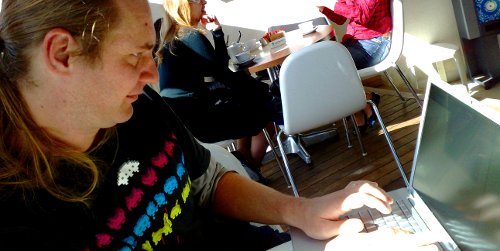
Originally, we had imagined having a management interface for the Village Telco very similar to the Meraki and/or Open-Mesh network management “dashboards” which are graphically-intuitive and easy for anyone to understand at a glance what is going on in the network. However, Antoine introduced a new twist which opens up interesting possibilities. He has designed the Afrimesh software so that it can run on any OpenWRT-based device. It is written entirely in JavaScript. Actually Afrimesh will run on just about anything but, for me, the interesting new possibility is have a dashboard interface that runs on the mesh devices themselves. I didn’t initially appreciate initially the potential that this opens up.
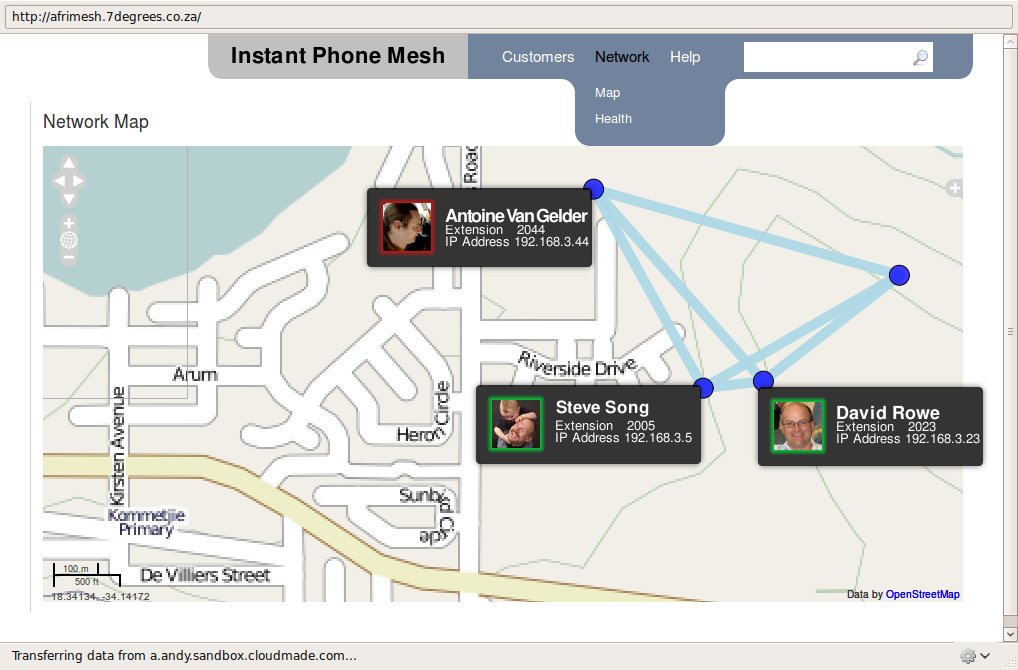
 You can see at the left here what the management interface currently looks like. As things currently stand, Afrimesh is designed to:
- monitor the health of the network and display connectivity information for each mesh node and connections between the nodes in a visually intuitive manner;
- provide an interface for the configuration of a B.A.T.M.A.N.-based mesh network; and,
- be an extensible GUI framework for interfacing with a mesh network.
From self organising data networks to self-organising phone networks
So here is where my minor epiphany came. What is great about mesh networks is that you just plug them in and they work. They self-organise in terms of upstream connectivitity, redundant routing, etc. They are a very, very clever way of quickly establishing a pervasive, reliable IP-based network.
With the Mesh Potato, we are trying to leverage the power of mesh networks to set up a phone network. Each Mesh Potato access point will have an RJ11 port, into which an everyday phone can be plugged. However, to use the Mesh Potato, some configuration of the phone network detail is still required. People need to have phone numbers to dial and a phone number themselves that people can call. More than that, people have to have a way of finding out other people’s phone numbers.
I began to think of the Mesh Potato in different environments to that which we originally conceived. For instance, would Mesh Potatoes work in an crisis environment where there was a need to set up a instant phone network? Could they be designed to self-configure out of the box as a phone mesh? Conversations with David Rowe and Antoine have encouraged me to think so.
Imagine you power up your Mesh Potato and an interactive voice response system says:
| Mesh Potato | “Welcome to the Mesh Potato network. Please speak your name after the tone.” |
| User | “Steve Song” |
| Mesh Potato | “Thank you. Please key in the letters of your last and first name so that other users can find you in the directory” |
| User | “S-7777, T-8, E-33, etc, etc” |
| Mesh Potato | “Thank you. You are now registered on the Mesh Potato network. Your extension is 2005. Please select from the following menu:
|
This is quite a reasonable scenario. We could set up the Mesh Potatoes to do something like the above and the impact would be that you could unpack a box of 24 Mesh Potatoes, power them up (battery or solar), and within minutes have a working phone network. This would work with or without upstream connectivity. It would mean you could immediately start delivering value with a Village Telco even before you have a server, billing, and upstream connectivity set up.
The Afrimesh Potato
 But it gets better. With the Afrimesh software, you could conceivably combine data network information with phone network information. Consider an enhanced version of the Afrimesh interface which not only provided network information but also voice call information. The image at the right is my mock-up but it conveys the sense of how Afrimesh could show you who was on the phone network, what their extension is, whether they’re “available”, etc.
I think that having a plug-and-play Mesh Potato that will allow people to start talking with no initial technical configuration would substantially increase the take-up rate of the Mesh Potato. I also think the Afrimesh interface offers opportunities for interesting voice/data/presence/twitter/jabber cross-over innovation on the MPs. Love to hear thoughts from others on this.
P.S. For those waiting patiently to hold a Mesh Potato in your hand, David and Elektra are in the final stage of PCB design with Atcom. I don’t have a date but we should have prototypes very shortly.